
Checking Criminal History in Livingston County
Begin with the source that answers the actual question. A prosecution belongs in MiCOURT Case Search. Select Livingston's 53rd District Court for misdemeanors and the early stage of a felony. Select the 44th Circuit Court for a felony after bind-over. Search both when the stage is not known. The free register of actions shows case events, but the clerk remains the source for pleadings, orders, and certified copies.
A sheriff report or booking file follows a different route. Call Jail Services for current custody, then identify the arresting agency before requesting the incident narrative. Use ICHAT only when the goal is reportable Michigan criminal history. It is a paid name search, not a fingerprint-confirmed identity check or a live county booking log.
- Write down the full name, date of birth, spelling variants, likely agency, and approximate event date.
- Search both Livingston courts in MiCOURT if a felony may have moved from District to Circuit.
- Call the jail for present custody or request the report from the agency whose officer made the arrest.
- Run ICHAT for reportable statewide Michigan history, then compare its case details with the court record.
- Ask the proper clerk or records counter for a plain or certified copy when the document itself matters.
Note: A missing result in one system does not prove that no related Livingston County record exists in another.
Three Livingston Criminal Record Products
Booking, court, and state history records sound alike, yet each proves something else. The Livingston County Jail creates an intake record when a person enters custody. The courts record allegations, hearings, orders, and disposition. Michigan State Police CJIC compiles qualifying reported events into the statewide history available through ICHAT.
- Arrest or booking file
- Best evidence of a custody event, intake time, initial charge, and bond at that point, but not guilt or the final filed charge.
- Court register or file
- Best evidence of filed counts, hearings, orders, outcome, and sentence, but not every unfiled arrest or a statewide history.
- ICHAT response
- Best evidence of reportable Michigan criminal-history cycles, with warrants and several local, juvenile, federal, tribal, and out-of-state categories omitted.
The strongest Livingston County record check compares the matching identifiers and dates without forcing one product to do another's job. An intake charge can change when the prosecutor reviews the report. A court dismissal also does not erase the fact that a separate arrest report was once created.
Michigan Official Background Checks
The Michigan State Police Criminal Justice Information Center maintains the state repository. ICHAT lets any member of the public create an account and buy a name-based search for $10. The search uses a first and last name, date of birth, and other descriptors. A result may include reported felony arrests and convictions plus serious-misdemeanor convictions. It excludes suppressed records, warrants, juvenile and traffic matters, federal and tribal history, other states, and some local misdemeanors.
For review of one's own fingerprint-linked Michigan record, obtain an RI-008 fingerprint card from local law enforcement. Send the completed card, cover letter, return information, and $30 payment to MSP CJIC. MSP states a three-to-five-week processing period. An authorized electronic check instead starts with form RI-030 from the agency authorized by law, followed by capture at an approved Michigan Live Scan vendor or law-enforcement site.
| Official product | Access | Base fee |
|---|---|---|
| ICHAT name search | Online account and subject identifiers | $10 per search |
| Personal fingerprint review | RI-008 card mailed to MSP CJIC | $30 |
| FBI Identity History Summary | Subject fingerprints through the FBI direct channel | $18 |
| Adult set-aside processing | Application packet and fingerprints sent to MSP | $50 MSP fee |
Livingston Criminal Records on Highlander Way
Many Livingston County criminal records are held within a short stretch of Howell, but the counters are not interchangeable. The Livingston County Judicial Center at 204 S. Highlander Way houses the 53rd District Court Criminal Division in Suite 1 and the Circuit Court Clerk in Suite 4. District handles misdemeanor cases and felony arraignment and preliminary examination. Circuit keeps the felony file after bind-over. Court hours are generally weekdays from 8:00 a.m. to 5:00 p.m., with Circuit paperwork processed through 4:45 p.m.
The sheriff and jail are at 150 S. Highlander Way. Central Records handles sheriff incident reports, local records checks, fingerprints, field contacts, crashes, and sex-offender registration. The County Administration Building at 304 E. Grand River Avenue holds the county FOIA route. General County Clerk service at 200 E. Grand River is not the criminal case counter.
53rd District Court Criminal
204 S. Highlander Way, Suite 1
Howell, MI 48843
(517) 548-1000
44th Circuit Court Clerk
204 S. Highlander Way, Suite 4
Howell, MI 48843
(517) 546-9816
Sheriff Central Records
150 S. Highlander Way
Howell, MI 48843
(517) 546-2440
Courts are outside county FOIA. Ask the court clerk directly for a case document, and use Livingston FOIA for an executive-branch county record such as a sheriff report.
Criminal Record Types
Livingston County criminal history is a chain of records, not one file. An officer first creates an incident report. If custody follows, jail staff create a booking record and take fingerprints. The Prosecuting Attorney decides which charges to authorize. A District Court case may later produce a separate Circuit Court file. Courts and prosecutors then report qualifying disposition data to MSP CJIC.
- Incident and arrest reports: agency narratives describing the event, probable cause, evidence, and initial suspected offenses.
- Booking records: jail intake data, holds, bond, fingerprints, property, housing, and release activity.
- Court case files: complaints, motions, hearings, pleas, verdicts, sentences, and postjudgment orders.
- Warrant records: judge or magistrate orders, with only some active Livingston warrants shown publicly.
- State records: ICHAT, MDOC OTIS, and PSOR products, each with its own scope and limits.
City police remain the holders of their own reports even when an arrestee is booked at the county jail. Howell, Brighton, and Fowlerville criminal cases still converge in the Livingston County courts because none has a separate municipal criminal court.
Searching Livingston Criminal Cases in MiCOURT
MiCOURT is the main free starting point for filed Livingston County cases. Choose the court first. A case number is the cleanest key, while a party-name search needs careful spelling and identity checks. The interface changes with the court and case type, so not every field appears in every search. Protected or suppressed cases do not appear.
| Field | Use | Livingston note |
|---|---|---|
| Court | Required court selector | Choose 53rd District or 44th Circuit |
| Case number | Direct case route | District and Circuit numbers may differ |
| Party name | Last and first name search | Confirm spelling and match details |
| Date of birth | Optional narrowing field where offered | Public display may be limited |
| Case type | Optional filter | Select Criminal when available |
Open the register of actions and confirm the court name, case type, filing date, status, and assigned judge. For a full explanation of pleadings and the felony handoff, use the Livingston County criminal court cases resource. Online docket text may not include a downloadable image, so contact the relevant clerk for the underlying order.
Inside a Livingston County Criminal Record
The fields depend on the product. A statewide history links an identity segment to reported arrest and disposition cycles. A court file adds the judge, counsel, bond, hearing dates, orders, and financial entries. A jail file adds intake, property, photograph, classification, and release fields, though medical, security, and detailed classification information is not treated as public merely because staff use it.
| Name and identifiers | Current or former names, birth date, physical descriptors, and state or biometric identifiers where law permits display. |
|---|---|
| Arrest and booking | Agency, date, tracking or booking number, intake charge, hold, bond, and release activity. |
| Charges and statutes | Initial, authorized, amended, and conviction offense text with Michigan law citations. |
| Disposition | Dismissal, acquittal, plea, verdict, conviction, or another final result by count. |
| Sentence | Jail or prison, probation, fines, costs, restitution, and related orders where public. |
| Custody or supervision | County jail status, MDOC prison, probation, parole, transfer, or discharge within the source's scope. |
Read charge dates and disposition dates together. The offense printed at booking may not match the prosecutor's authorized count or the conviction entered months later.
Livingston Jail Records and OTIS
Livingston County does not expose a conventional public online inmate roster. For present custody, call Jail Services at (517) 546-2445. The jail at 150 S. Highlander Way has a rated capacity of 411 and processes more than 5,000 admissions in a year, according to the sheriff. Those admissions are custody events, not a count of convictions or unique people.
The official Livingston County Sheriff source documents the agency and the scale of its booking operation.
The image reinforces why current jail questions should stay on the county's official domain, especially because the sheriff warns about a similarly named unofficial jail site.
Use MDOC OTIS only after state custody or supervision becomes relevant. OTIS can cover prisoners, parolees, probationers under MDOC supervision, and people discharged in the last three years, subject to exclusions. A person absent from OTIS may still be in the county jail, may never have entered MDOC, or may fall outside its display window.
Livingston Criminal Records Beyond County Systems
Several official sources sit outside the Livingston County record chain. The Michigan Public Sex Offender Registry supports name and address searches for public registry entries. It is not a full criminal-history search. A profile may show identity, photograph, registration status, tier, qualifying conviction, address, campus, and vehicle data when state law makes those fields public. The Sheriff's Central Records office handles local registration questions, while Michigan State Police manages the statewide public system.
Federal cases require a separate search. Livingston County is within the U.S. District Court for the Eastern District of Michigan. PACER contains federal dockets and filed documents, while the Bureau of Prisons locator covers federal custody. Neither MiCOURT nor ICHAT substitutes for those sources. Sealed federal matters and protected identifiers remain unavailable.
The Livingston County Prosecuting Attorney reviews and authorizes state charges, so an officer's arrest label can change before filing. The full-time County Public Defender office in Brighton handles qualifying appointed criminal defense but does not maintain the public court record. For a filed outcome, return to the District or Circuit clerk. For defense eligibility or client material, use the defender's own office channel.
Public Access Laws in Michigan
Michigan law routes access by custodian. Livingston FOIA reaches nonexempt sheriff and county executive records, while court files are governed by court rules. Criminal-history dissemination, fingerprint reporting, set-aside rules, and registry use each have separate statutes. Redaction can protect personal identifiers, juveniles, victims, medical facts, security data, and active investigative material.
Key Michigan authorities:
Michigan FOIA, MCL 15.231-.246 gives access to nonexempt public-body records and sets response procedures, but does not govern courts.
MCL 28.242a defines criminal-history record information maintained by Michigan.
MCL 28.243 governs arrest fingerprints, disposition reporting, and specified destruction rules.
MCL 780.621 sets application-based conviction set-aside eligibility.
MCL 28.730 controls public registry access and forbids harmful misuse.
A public record can still have limits. Verify the current status with the office that created the file before relying on a copied or older version.
Livingston Criminal Report Requests
Sheriff Central Records is the local fallback for a Livingston County incident report. Most police reports are estimated to take seven to ten days to process. Crash reports may take five to seven days and can be purchased through the Michigan State Police Traffic Crash Purchasing System for $15. Those working estimates differ from the FOIA response deadline.
Under Livingston County's FOIA process, the agency generally responds within five business days by granting, denying, partly granting, or taking one extension of up to ten more business days. A response is not always the final production date for a large or heavily redacted request. An individual request must include a complete name, mailing address, and a valid phone number or email.
Describe the agency, incident number, date, location, desired report components, and preferred format. Do not send a sheriff FOIA request for a Howell or Brighton police narrative. Ask the department whose officer wrote it. Court documents must go to the District or Circuit clerk, not the county FOIA coordinator.
Sealed, Expunged, and Restricted Records
Michigan uses “set aside” as the statutory term, while courts and agencies also say “expungement.” A set-aside removes a qualifying conviction from ordinary public view but does not destroy every state record. Juvenile files, sealed warrants, protected victim data, personal identifiers, qualifying active-investigation material, and the nonpublic side of the sex-offender registry also have access limits.
Application eligibility and waiting periods depend on the number and kind of convictions. General waiting periods are seven years for more than one felony, five years for one felony or one or more serious misdemeanors, and three years for one or more non-serious misdemeanors, subject to the statute. Michigan Clean Slate also grants automatic set-asides to some qualifying convictions, but not every record that might qualify through an application.
The Michigan State Police set-aside source shows the state packet and processing route.
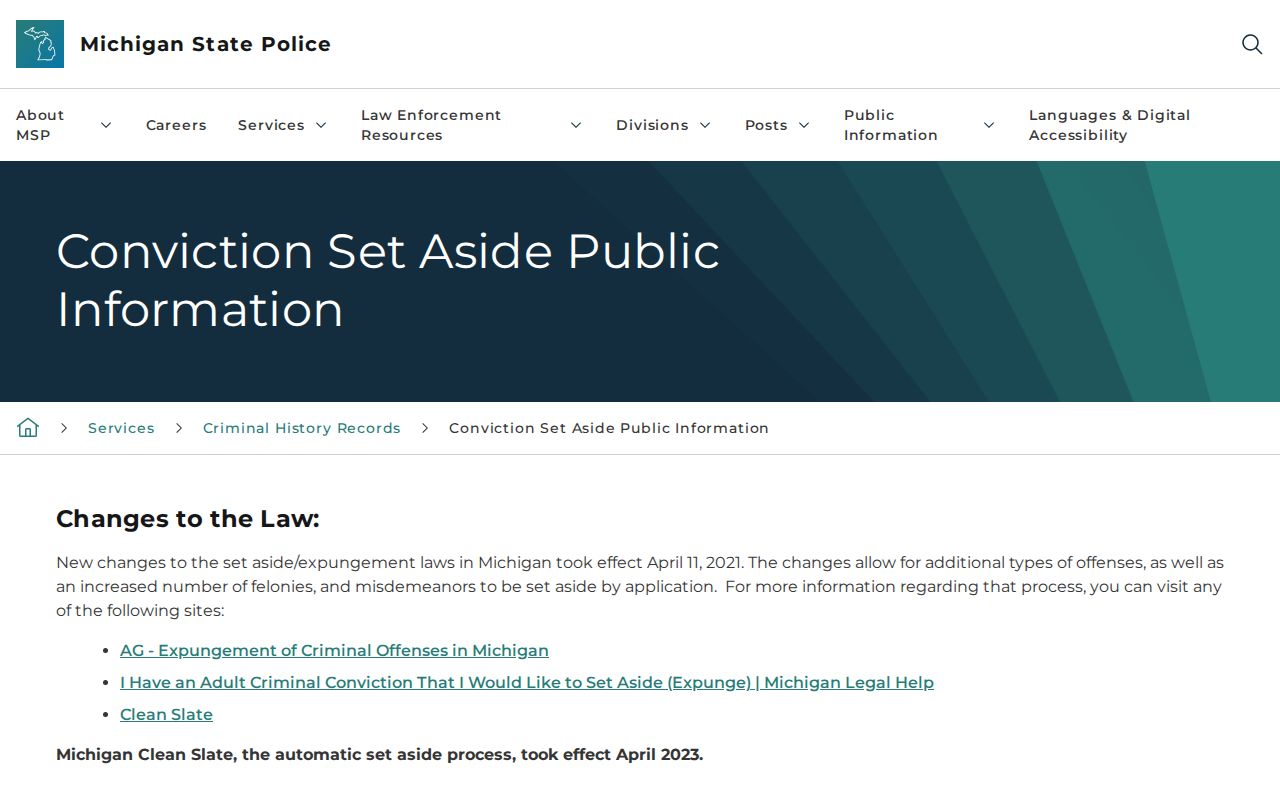
The state material supports checking ICHAT, the Livingston court file, and one's fingerprint record before filing, then serving every party named by the form.
Livingston Warrants and Supervision Records
The 53rd District Court publishes a Livingston active-warrant list and warns about fraudulent calls that demand payment. Verify instructions at (517) 548-1000 through the court's published number. The court lists a weekday walk-in window from 9:00 to 9:30 a.m. for certain felony, misdemeanor, and civil-infraction warrants, but only the judge or magistrate decides bond, recall, or new conditions.
Misdemeanor probation is supervised through the 53rd District Court Probation Department. Felony probation follows the Circuit and MDOC framework. Parole falls under the Michigan Parole Board within MDOC. Check the sentencing court register first, then OTIS when MDOC supervision is involved. Officer notes and all probation conditions are not presumed public just because the sentence appears on a docket.
The official OTIS search interface supplies name, MDOC number, status, and descriptor fields for covered supervision records.
OTIS should be compared with the Livingston court sentence because its supervision view does not replace the court's full register of actions.
Livingston Criminal Record Terms
Local case searches become easier once a few Michigan terms are clear. They mark where a felony sits, whether a case ended, and what release or supervision means.
- Bind-over
- The transfer of a felony from 53rd District Court to 44th Circuit Court after waiver or a probable-cause finding.
- Register of actions
- The clerk's dated list of filings, hearings, orders, and other events in a case.
- Disposition
- The result of a charge, such as conviction, dismissal, acquittal, or another terminating outcome.
- Personal recognizance
- Release based on a promise to appear and obey conditions without posting a cash amount.
- Set aside
- Michigan relief that removes a qualifying conviction from normal public view while preserving restricted access allowed by law.
A “two-year misdemeanor” can also cause confusion. Michigan labels it a misdemeanor, yet it can be treated like a felony in important procedural respects. Always read the cited offense statute and the court route rather than assuming the label tells the whole story.
Livingston County Criminal Records by City
Howell and Brighton are Livingston County's two legally designated cities. Fowlerville is the next-largest incorporated place and is a village. Each police agency keeps its own incident reports, but all three places send criminal filings to the countywide 53rd District Court and then to the 44th Circuit Court when a felony is bound over. The local cards preserve that city or village distinction.
Howell Criminal Records
County seat · City Police reports remain separate from Sheriff records, while court cases route to Highlander Way.
Brighton Criminal Records
Brighton Police and the City Clerk handle city records before county court and jail channels apply.
Fowlerville Criminal Records
Village Police or the Sheriff may hold a report depending on the exact place and responding officer.
The city incident number, county court case number, and jail booking number are separate identifiers. Keep all of them when tracing a Livingston County event from report to final disposition.